|
| My favourite Ned. |
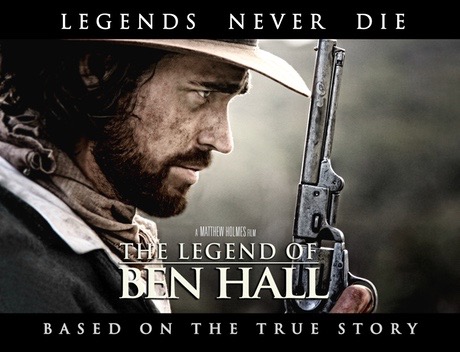
Hard on the heels of the
terrific bushranger movie, ‘The Legend of Ben Hall’, comes the announcement from
the same Director of a crowdfunding campaign, beginning later this month to
make another Bushranger movie. This was not unexpected as all throughout the
campaign to fund produce and then promote ‘The Legend of Ben Hall’, Matthew
Holmes constantly referred to it as being just the first of a series of films
about Bushrangers. However what is
unexpected, is that rather than making movies about John Vane and Frank Gardner,
the ‘prequel’ movies he had repeatedly said he would produce next, he has
instead decided to make a movie about Ned Kelly. Why he has changed his mind is
not explained anywhere that I can find, but I suspect it has something to do
with the two hard-core Kelly sympathisers who took Matthew on a tour of various
Kelly related historical sites recently. They posted video-clips on Facebook
that show them explaining to Matthew the significance of the various places and
what happened there. He seemed quite impressed by it all, and is now
proclaiming that this Ned Kelly movie will be unlike any other because it will be
‘free of prejudice or agenda, based solely on the facts and the evidence
we have on hand. Not based on a novel or an opinion, not mingled with Hollywood
fancy and nonsense”. He’s enlisted the help of these two Kelly sympathisers
as screenwriters and at every opportunity is stressing that this movie will be
as historically accurate as he can make it.
The idea of a movie about Ned
Kelly that’s based ‘solely on the facts and
the evidence we have on hand, not based on a novel or an opinion’ is a
terrific one, and would be a movie I would certainly love to see. Kelly sympathisers in their scores are
applauding him and getting very excited at the prospect, and with good reason
because Matthew Holmes first feature film on the Legend of Ben Hall has shown
he certainly has the ability to do it.
So what would a Kelly movie that
ignores ‘opinion’ and is based on facts and the evidence at hand look like?
Well, if Holmes is going to continue with the same approach used in his first
movie, he is going to make extensive use of the newspaper reports of the time, of
Police records and Court reports, as well as contemporary writings, and isn’t
going to rely on ‘opinion’ which is what 'folklore' and 'oral tradition' mostly is. And just as
he accepted guidance and advice from a modern day Hall historian, Peter Bradley,
he should look to modern day Kelly historians for advice and guidance in the
same way. Here I am not referring to the old guard who cooked up the modern
Kelly myth, people like Jones and McMenomy, or the rank amateur co-screenwriter
who grandly calls himself a Kelly historian, but people like Ian MacFarlane, Dr Russell Scott, Doug Morrissey, Stuart Dawson and Grantlee Kieza. These people are all serious
academics and historians and cannot be ignored as they are part of the ‘evidence on
hand’ They have added insights and knowledge to the Kelly story that wasn’t
around 50 years ago when the modern Kelly myths were first developed.
To start with then Holmes will
not be able to suggest the Kellys were persecuted and hounded by the Police and
that Ned Kelly was a Police-made criminal. This idea was invented by Ned Kelly
and proclaimed in the Jerilderie Letter, the tired refrain of criminals down
the ages and an opinion repeated by Kelly sympatisers that its all the polices
fault. Its the most central of all the Kelly myths, the one that in the minds of Kelly sympathisers justifies everything that happened once Ned Kelly decided to rebel against it. However, as Ive shown on this Blog by careful review of the actual details recorded in the news and the court reports of the time, there is no support for that idea at all - its a myth. The records show that the
police took almost no interest in Neds’ immediate family until after Red had
died, and later, when Ned was apparently ‘going straight’ the Police again took
no interest in their lives; the records also show that the Kelly’s court
appearances were for actual crimes and followed genuine complaints rather than the
purported manufactured excuses to harass them; the Court records show that
whenever Kellys appeared in Court they were treated according to the Law;
charges were often dismissed or reduced, and sentences were remitted for good
behaviour; the 1881 Royal Commission said there was no such persecution. The
record also shows that in 1877 Nicholson ordered the Police NOT to upset or
trouble the Kellys in any way, unless they committed a crime, even a paltry
one. By then, Ned Kelly had been in Gaol for assault and indecency, had avoided
a conviction for assaulting a Chinaman on the dubious testimony of associates,
and served three years for horse theft. Doug Morrissey revealed why that conviction
was fair, for its time, and not a travesty as always asserted by Kelly supporters. Many other members of the extended Kelly and
Quinn dynasties and various members of the Greta mob had also been before the
Courts and served time in jail – by 1877 the Police were running out of
patience. These are the facts supported by the documentary evidence of police
and court records and newspaper reports from the time. The idea that the Kellys
were persecuted and unfairly victimised by Police is a claim made by Ned Kelly, an opinion unsupported by
evidence, and nothing else. It shouldn't be in any movie based 'solely on the facts and the evidence'.
When it comes to the so-called
Fitzpatrick incident, Holmes will be obliged to portray Ned Kelly as having
been there, because that’s what the evidence shows. The only ‘evidence’ that he
wasn’t there are Neds own words, which even Ian Jones regards as lies. Holmes
will have to take into consideration Ian MacFarlane and Stuart Dawsons writings
about Fitzpatrick, who has been forever maligned on the basis of the
unsubstantiated claims of a fellow Policeman. The documentary evidence
regarding Fitzpatrick in 1880 is a
petition, signed by more than 100 people including JPs and an
MP, wherein he is described among other things as “zealous diligent obliging and universally liked”. So is Holmes
going to prefer an unsubstantiated allegation that has been used to blacken the
name of Fitzpatrick from 1878 till now, or an actual contemporary
document? Kelly sympathisers love to
express great moral outrage at the way Fitzpatrick conducted his private
affairs as a young man, but they were nothing out of the ordinary - Ben Hall
had numerous girlfriends and affairs but he is not condemned for it! So, it is
generally accepted did Joe Byrne, and Aaron Sherrit, and when have any of the
Kelly sympathisers applied the same moral judgement to Mrs Kelly who also had
lovers and illegitimate children? But if Fitzpatrick subsequently behaved
badly, could that not be a consequence of the appalling manner in which he was
publicly humiliated by the Police force who made a scapegoat of him and dismissed
him on the uncorroborated word of a
senior colleague? The Royal Commission however did NOT condemn Fitzpatricks
actions at Greta, though without asking for any corroboration it mistakenly accepted
the later criticisms of him.
And what is Matthew Holmes
going to make of Stringybark Creek? Is he going to recycle the unsubstantiated
myths about ‘body straps’, the wrong imputation that being in plain clothes
meant the police were in disguise, the oft repeated nonsense about the police
being ‘armed to the teeth’? None of these familiar lines from the Kelly
mythology is supported by any actual evidence, but are merely the kind of “opinions”
that Holmes said will not be informing the movie – he wants facts, so those furphies will be excluded! Is he going
to accept Kellys claim that he killed Lonigan in self-defence with a single
shot when he lifted his head up from behind a log - or the evidence from the
autopsy? This showed that Lonigan had not one but four wounds, all inflicted
while he was alive and several were in places that couldn’t possibly have been
hit if Lonigan was behind a log. That evidence, and McIntyres testimony show
that Lonigan was shot almost immediately after he was ordered to bail up, when
he hesitated to do exactly what Kelly demanded. The evidence and the facts here
show Kelly lied. Is he going to portray Kennedy's murder as a mercy killing, as Ned Kelly sanctimoniously pretended it to be, or as the sinister hunting down of a man fleeing for his life, only to be killed once his revolver was spent? The word of a proven liar is the only evidence to support the former scenario over the actual forensic evidence and the details from the crime scene, a long way away from the Camp where the original attack took place.
Then there is Glenrowan, the place
where Holmes co-screenwriter Steve Jager claims Ned Kelly planned to start a
civil war as a prelude to declaring north-east Victoria a Republic. There is
simply not one piece of documentary evidence to support this idea, and the
evidence we DO have about why Ned Kelly embarked on this ‘madness’ as Ian Jones
called it, is that he was acting out his hatred of police and possibly also
hoping somehow to free his mother from prison, even though by mid 1880 she had
only a few more months left on her sentence. Is he going to portray the
gathering of prisoners in the Ann Jones Inn as a hilarious bit of fun or as a terrifying
experience for many of them and a demonstration of Kelly’s utter disregard for
the lives of innocent men women and children? They were all deliberately placed
in harm’s way and kept there even when it was evident to everyone once the ghastly horror of a train smash had been
averted that the plan had failed and the only possible outcomes for the gang
were either capture or death. Who is Holmes going to portray as being
ultimately responsible for the loss of innocent life there? And is Holmes commitment to telling the truth sufficiently robust to allow him to expose Kellys plan for Glenrowan as being a mass killing that would have had a toll of innocent lives similar to the Port Arthur massacre? Is that not a fact? Is Holmes going to allow the question to be asked of Ned Kelly "Why wasn't killing three Police enough?"
My guess is that Holmes will
succeed in making an entertaining and exciting movie – it would need an
appallingly bad Director to make a movie about the life of Ned Kelly that
wasn’t! However, unlike his great first movie, The Legend of Ben Hall, I very
much doubt his version of the Life of Ned Kelly will be ‘free of prejudice or agenda, based on facts and the evidence on hand,
not based on a novel or opinion’. In fact I am almost certain he will pass
up this golden opportunity to do something really radical with the Kelly legend
and tell the truth about it at last, but instead serve up yet another recycling
of the tedious Kelly mythology that modern Australia is actually moving on
from. And this is why:
Firstly he has written on Facebook
that there is “no feature film to date that has explored the Kelly story completely and
accurately, with the exception of Ian Jones' 'The Last Outlaw'. The Last Outlaw, the 1980 TV
miniseries was widely acclaimed and is still popular amongst Kelly
sympathisers, but it is laden with unhistorical Kelly myths and legends, and
portrays Ned as the hard-done by innocent selector, demonises the Police and Fitzpatrick,
promotes the Republic myth and leaves out much that’s unpalatable. If Holmes
watched it critically, he should have known this, so one is left to wonder how
much Holmes really knows and understands about the Kelly story.
Secondly, Holmes has enlisted
as co-screenwriters two well known dedicated Kelly symapthisers. One calls
himself a Kelly historian and researcher but he is misusing the word historian.
He is a person who has openly expressed contempt and disrespect for science and
scientists, and for actual research by actual historians , and on the Kelly country
Facebook video posts makes a number of elementary blunders, and exposes his commitment
to the pure form of the Kelly myth. Ask these Kelly sympathisers what their
opinions are of real Kelly historians and researchers like
McDermott, MacFarlane, Morrissey, Dawson and even myself – whenever Jager
mentioned these people on the Ned Kelly Forum it was only to dismiss and
ridicule them. Ask Jager what he thinks of the work of scientists : Jager
rudely dismissed the work of the scientists who identified Ned Kellys bones,
claiming on the Ned Kelly Forum (which he eventually destroyed) that the
majority of the research findings claimed by the scientists ‘were
taken from Kelly researchers” and “as it was required by law that the remains were to be identified at the
VIFM, it hardly makes any of the contributors to the book "experts",
when in all fact they are just doing their job and trying to profit from Ned's
story.” From the Videos he posted on Facebook recently
its clear Jager also doesn’t accept the findings of the scientists at the
Australian Nuclear Science and Technology Organisation (ANSTO) who showed that
a piece of metal on display at the Kelly Vault is not the offcut from Joe
Byrnes armour that its finder claims –
Jager repeated the false claim that it is. On another of those videoes
he described Glenrowan as the place
where Ned Kelly planned to start a civil war, an uprising to establish the
Republic of North East Victoria, the centrepiece of Kelly mythology and a
completely unhistorical fantasy. He proclaimed on the Ned Kelly Forum that a
piece of Kellys armour seen in a photo taken in the 50’s had disappeared and he
was on a mission to find it – in fact nothing was missing. Jagers claimed ‘back
lappet’ was actually just the shoulder piece hanging in the wrong place. He
hadn’t noticed it was missing from the shoulder in the photo! He has also
publicly claimed to know “without a doubt” where Ned Kellys skull is. The
reality is Jager is not a historian, and he has publicly expressed an attitude
of disrespect for real scholarship and
for scientists, and appears to have no understanding of the way science works,
appears to have no idea of the necessity for a real historian and researcher to
be objective, and he wont hesitate to dismiss Police and Court reports as
cover-ups and newspaper stories as
corrupt, or the opinion of actual experts when they contradict his preconceived
Kelly stories. This behaviour might be understandable from an ignorant Kelly
sympathiser but from a person who claims to be a Kelly historian and
researcher? If Holmes works with someone like Jager, to keep him happy he will either have to significantly compromise
on his commitment to accuracy and being true to the historical record, or else
get rid of the sympathisers. Bringing them on board as co-screenwriters may
well be a decision he comes to regret.
Thirdly, Holmes has fallen for
the ‘false dichotomy’ argument used by climate-change deniers, creationists and
the Kelly writers alike. This is a tactic that’s designed to attract support to
their cause by making their weak and unsupportable arguments appear more
credible than they really are, by placing them alongside the scientific case
and claiming they are equivalent. Then, as Holmes wrote in a response on the
True Story Facebook page ‘let the audience decide what they
think of Ned Kelly once all is laid out on the table’. In the creationist and climate
change debates bad science, discredited argument and false facts are presented
as having equivalent weight to the overwhelming consensus of scientific evidence
– a false dichotomy that an ordinary non-scientist often doesn’t recognise. What
this does is create an impression that in the end the argument is so finely
balanced that either opinion can be supported. Kelly writers have been doing
this for decades, and it appears Holmes has fallen for it. In fact the arguments based on facts and the evidence are overwhelmingly unsupportive of the Kelly myths. The curious reality in the Kelly world is the dogged refusal of sympathisers to accept the arguments based on facts and evidence. Maybe Holmes movie will help them to see the truth.
Its interesting that Holmes claims that in the Legend of Ben
Hall he put out the facts and let the viewers decide. He declared that his goal
in the Kelly movie “as
a storyteller is to HUMANISE everyone within the story, to look at it from
every perspective and to help the audience understand WHY this story happened,
not to force the audience into a pre-determined conclusion.” (His caps). This is a commendable goal but these
comments suggest to me that Holmes believes he can remove himself and his own
subjectivity from the process and produce a movie that’s effectively untouched
by human hands. Either that or he is pretending that he can, as part of a
tactic designed to make what he eventually produces seem more credible. I don’t believe a story can EVER be told from “every
perspective” , or that a movie can be insulated against the makers own
persepctives and opinions and prejudices. In fact despite these expressions of
intent, in The Legend of Ben Hall Holmes didn’t just present the facts for the viewer to weigh up, or present ‘every
perspective’ on the story. He didn’t present two types of Ben Hall but he made
the case for the sort of conflicted person he considered Ben Hall to be, and portrayed
him in that way, and I think he did it brilliantly. What the viewer had to decide was how credible
was Holmes portrayal. This is what he should aim to do in the Kelly movie as well,
and not kid himself that he is going to produce a movie that just presents the
facts, that tells the story from every perspective so the audience can make up
its own mind. What he WILL do for certain, no matter what he says or even
thinks he is doing as he did with Ben Hall, is make a movie from a certain
perspective, and the audience will make its mind up on how well he does it.
When it comes to telling the story of Ned Kelly however,
Holmes has taken on a much more complex task, because the true story of Ned
Kelly is buried under an almost impenetrable layer of legends and stories and
oral history and myth that has almost completely hidden the person at the centre
of it all. If Jager and Phelan have their way, the truth about Ned Kelly will not come out. I’m expecting a
rehash of the unhistorical Kelly myths that glorify a police murderer and liar,
not a Kelly story that has credibility other than as entertainment, and damage
to Holmes good reputation as someone committed to writing true history.
This is my challenge to you Matthew Holmes : dump the tired old Kelly mythology, dump the Kelly fanciers who are trying to pull the wool over your eyes, dump the idea that The Last Outlaw was in any way accurate and historical, read MacFarlanes book and Morrisseys book and Dawsons writing and Grantlee Kiezas book and have the courage of your instinct to produce the true story, the definitive story genuinely based on facts and evidence. It will still be an absorbing and exciting movie, and you're the person with the genius to make it.
This is my challenge to you Matthew Holmes : dump the tired old Kelly mythology, dump the Kelly fanciers who are trying to pull the wool over your eyes, dump the idea that The Last Outlaw was in any way accurate and historical, read MacFarlanes book and Morrisseys book and Dawsons writing and Grantlee Kiezas book and have the courage of your instinct to produce the true story, the definitive story genuinely based on facts and evidence. It will still be an absorbing and exciting movie, and you're the person with the genius to make it.