
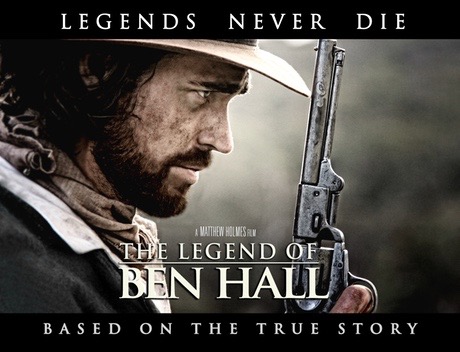
In 2014 a movie maker who didn’t go to Film School launched an ambitious
crowd funding bid to raise $75,000 to make a short film that would be ‘…. a highly-realistic,
cinematic and gritty 40-minute narrative depicting Ben Hall in the final days
of his life, culminating in his controversial death outside Forbes NSW in 1865.
We want this film to be ready for the 150th anniversary of Ben Hall's death,
which is next year - May 5th 2015.
We want to resurrect this story from history books and explode
it onto the screen in a glorious, sweeping way for a whole new generation to
discover - in High Definition and surround sound. Australia has been waiting
decades for a Ben Hall film; the time has come to deliver one.
Too often, film adaptations stray
from the real history. Not our film. Nobody will have ever depicted the Ben
Hall story in the level of detail and historical accuracy as we plan to do.
From the weapons and costumes, to the characters and dialogue - this level of
authenticity is rarely seen.
Beyond pure entertainment, The Legend of Ben Hall will also be used to raise Australia's awareness of our colonial
history and promote tourism in central NSW. We will also enter the film into
dozens of prestigious film festivals with hope of snatching up some coveted
awards! We even hope to get The Legend of Ben Hall on television!
In fact, they raised nearly
double their target, and managed to turn what seemed like impossibly high aspirations
even for a 40 minute short film into a full length feature, on a budget which
was never-the-less minuscule. It was finally released a bit later than they
hoped for late last year, has been shown in a very limited number of
cinemas, but now is available on DVD and BluRay.
I knew of its existence and
would have seen it if it was ever screened locally, but it wasn’t. Then, quite
recently it was announced that the same director, Matthew Holmes, was planning
another bushranger movie, this time about Ned Kelly, and again he plans to crowd-fund
it . I was challenged by Mark Perry to watch "The Legend of Ben Hall" before I jumped
to any conclusions about the planned “Legend of Ned Kelly” and so, when time
finally permitted, I found a copy at the nearby JB Hi Fi and watched it the
other night.
The movie is not about the
whole of Ben Halls life but about the last couple of years of his life on the
run, and ends with his death in 1865. There is therefore much of his life and
earlier bushranging career that is not depicted, though at various points in
the movie hints are given as to what went before and why. On-screen text says
that by 1864 he was the most wanted man in the British Empire, and the Reward
for his capture was the largest yet offered. The storyline is about Halls
attempt to save himself by abandoning a life of crime and fleeing the country, a decision which leaves
him awfully conflicted and in a desperate
quandary : to leave he will need funds which he can only get by continuing the
life of a Bushranger; to leave he will need to continue his association with the
unstable and violent criminal John Gilbert, and reluctantly draw others into
another Gang; to leave he will have to abandon the things that mean the most to
him, his first but now estranged love Biddy, and his young son William. The
filmmaker weaves together Halls doomed attempts to establish a relationship
with his son, his fight to control his companions and acquire the necessary funds
by highway robbery, and his struggle to evade capture long enough to escape to Queensland
into an absolutely spellbinding movie that would be brilliant on any budget,
but is even more so, because by comparison with most movies it was produced on
the smell of an oily rag and with a cast of virtual unknowns. It helps of
course to have the amazing backdrop of the Australian bush to set your movie
in, and there are breathtaking shots of the gang riding in silhouette along the
ridges against the setting sun, through crackling eucalypt forest echoing with
the call of whip-birds and kookaburra, and across dry grass plains studded with
rocky outcrops and ancient craggy gums – but it requires a kind of genius to
capture it all so exquisitely on film. I wondered now and again if there weren’t one too many of
these gorgeous scenes of men on horseback galloping across a landscape that
resembled a Tom Roberts oil painting, but certainly in Australia, people who
love horses and have been in the bush can probably never get enough of that kind
of beauty. But the movie is not just a grand visual feast, like a promo for
Outback NSW. There is a terrific tension built up between police and the
hunted, between the hunted and their increasingly wary supporters, and between the members of the gang itself; there is
passion and emotion that’s not overdone and sugary, there’s frivolity, dancing
and music, betrayal, tragedy, horror, bravery, and through it all the brooding
Ben Hall whose internal turmoil is barely contained. The scenes shot inside
houses, police stations pubs and stores are all equally as rich and convincing.
The opening sequence, where the face of the movies Ben Hall emerges from the
famous photo of the real Ben Hall is mesmerising. Ben leaving his son and
estranged wife for the final time is gut wrenching. Seeing panic-stricken John
Dunn shoot a policeman and father of
eight is shocking. John Glberts behaviour is often sickening. What Matthew Holmes has achieved with his unknown cast and the talent he has at his disposal is really remarkable.
This is a terrific movie that
succeeds on so many levels as entertainment, and deserves country-wide
distribution – I cant imagine any true-blue Aussie not giving it five stars.
But does it succeed as history?
The movie makers set themselves almost impossibly high hopes
for this film :
“Too often, film adaptations stray
from the real history. Not our film. Nobody will have ever depicted the Ben
Hall story in the level of detail and historical accuracy as we plan to do.
From the weapons and costumes, to the characters and dialogue - this level of
authenticity is rarely seen.”
Now, I almost never buy DVDs or watch movies anywhere other than in the
Cinema on the Big Screen, but I was forced to watch this at home on the DVD I
bought from JB HiFi. The benefit of doing this - something I didn’t realise until
I put the movie on - was that in addition to the movie you get some Extras: three
Trailers, A Directors commentary and a Historians commentary, this last one
provided by Peter Bradley, an actual historian who is also a descendant of Ben
Halls brother. On the DVD therefore you can then watch the entire movie again,
with the sound track and dialogue muted but a voice over by Bradley and Matthew
Holmes. I found t fascinating to listen to these two gentlemen discuss the
various scenes as they unfolded and describe the relationship between the scene
and various elements within it to what was actually known from history. I
learned that virtually everything depicted was something that actually
happened, but things were sometimes rearranged to better suit the narrative, or
left out or embellished in a way that was sympathetic to the true history but
which enhanced the story telling and the cinematic experience. Some things were
changed because of funding or scheduling constraints, but essentially the story
as told though not entirely accurate in every detail, was true to the historical
facts where it was important. Thus, its not really known if Ben Hall actually
abducted his son, but William did indeed
end up briefly in the care of others, its not actually known why Ben and
Biddys relationship broke down, Ben Hall didn’t ever give money to Biddy for
Williams care, and Goobang Mick had two children not one as portrayed in the
film. We are also told that a popular belief that the Aborigine Dargan was once
a childhood friend of Ben’s, was the person who killed him and that the Police
then used Bens corpse for firing practice is a popular myth with no historical
evidence to support it. Another Myth
they dismissed was that Biddys new partner was a former policeman. The boy named Supple who gave Police
information about the gang being in a hayshed was actually chased outside
before he was caught, but Holmes said when that scene was supposed to be filmed
it was raining so they decided to depict his detention as having occurred in
the Pub. I was most interested to hear Holmes talk about the Police replacing
shot in their shotguns with revolver balls! Holmes and Bradley constantly
referred to newspapers from the time and Police and court records as being the
documents on which they relied to ensure their recreations were accurate.
Thus, in my opinion they also succeeded
in their ambition to make the movie as close as they could to the historical
truth. They’ve carefully avoided repeating non-historical myths and oral
traditions that are not supported by the evidence, and they’ve avoided the temptation
to either demonise or venerate Ben Hall, a man whom the record seems to suggest
and who is portrayed in the movie as a complex and deeply conflicted individual.
However, Holmes acknowledges that because he didn’t actually kill anyone
himself Hall may have been accorded more credit than he deserved, and so he has
Dunn pose the question that Ben Halls story leaves everyone asking : “Do you
think you’re innocent in all this, that you aint got no blood on your hands?”
And Gilbert says “You’ve taken shots at hundreds of them, you could have killed
any one of them at any time”
Matthew Holmes spent many years thinking about and preparing to make
this film, and it has paid off because I think he has created a masterpiece,
and it richly deserves the Awards it has recently received.
5 stars with strawberries on top!
Matthew Holmes spent many years thinking about and preparing to make
this film, and it has paid off because I think he has created a masterpiece,
and it richly deserves the Awards it has recently received.
5 stars with strawberries on top!

